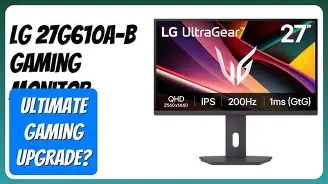
Don't Buy the 27G610A B Until You Read This Full Analysis
Introduction
The 27G610A B has arrived in many retailers' listings and community forums as a mid-sized display option that promises strong gaming performance and reasonable productivity credentials. Before anyone commits to a purchase, it is worth taking a careful, objective look at what the model offers, how it behaves in real-world use, and where trade-offs lie. This analysis walks through the monitor’s design, panel characteristics, gaming and productivity performance, common complaints, and who should — or should not — consider it.
Product overview and what to expect
At a glance, the 27G610A B is positioned as a 27-inch class display aimed at users who want a balance between smooth motion handling and everyday usability. The manufacturer highlights a high refresh rate, responsive pixel response modes, and a collection of gaming-oriented features such as adaptive sync and game presets. For buyers, the key considerations are whether that specification set translates into tangible benefits for their use cases and whether any compromises (panel uniformity, color accuracy, ergonomics) are acceptable for the intended workflow.
Design and build quality
The enclosure follows a contemporary, minimal aesthetic. The chassis is mostly matte plastic with a tidy cable pass-through and a relatively compact footprint for a 27-inch monitor. Stand ergonomics are an important practical detail: the 27G610A B typically offers tilt and limited height adjustment. In many user reports the stand is stable for daily desk use but does not provide full swivel or pivot. For users who rely on portrait orientation or advanced multi-monitor tiling, a VESA mount may be required.
Display characteristics and performance
Panel type affects most of the display’s strengths and weaknesses. The 27G610A B uses a widely used panel technology that aims to strike a balance between contrast, viewing angles, and response time. The screen supports a high refresh rate that benefits competitive gaming and general system feel. Response-time modes and overdrive tuning are included to reduce motion blur and ghosting, but results vary depending on content and the exact mode chosen.
Resolution and pixel density are central to the viewing experience. At a 27-inch diagonal, a typical Full HD (1920×1080) panel gives larger, easier-to-read UI elements but less desktop real estate, while a 1440p panel increases sharpness and workspace. Buyers should confirm the native resolution of the specific 27G610A B unit they are considering, since the perceived value depends heavily on whether the monitor is optimized for high frame-rate gaming at 1080p or higher-resolution productivity work.
Inputs, connectivity and on-screen menu
Connectivity usually includes at least one DisplayPort and one or more HDMI ports, plus a headphone jack. The on-screen display (OSD) menu exposes common adjustments: brightness, contrast, color temperature presets, and gaming options like crosshair overlays and refresh-rate indicators. The intuitiveness of the OSD varies model to model; some users find the joystick control efficient, while others prefer clearly labeled buttons. It is useful to test the OSD in person when possible, since frequent menu navigation for color or power settings becomes tiresome on a poorly implemented interface.
Color, calibration and HDR
Out of the box, color tuning on mainstream gaming monitors often prioritizes punchy saturation and contrast. The 27G610A B typically follows this trend, delivering visually appealing but not perfectly accurate color reproduction without calibration. Buyers who do photo or video editing should expect to perform a hardware or software calibration if they need reliable color accuracy. If the unit supports any level of HDR, it is likely to be entry-level: higher peak brightness and local dimming would be required for true HDR impact, which is uncommon on monitors in this class.
Gaming features and competitive performance
For fast-paced games, the combination of high refresh rate and low input latency is the primary selling point. Adaptive sync technologies (variable refresh rate) help eliminate tearing when frame rates vary, and low motion blur modes help reduce perceived ghosting. However, aggressive overdrive can introduce inverse ghosting artifacts; the practical advice is to test multiple overdrive levels to find the best balance for the game genres played. Multiplayer and competitive gamers who chase every millisecond will want to pair the monitor with a GPU capable of sustaining high frame rates at the panel’s native resolution.
Productivity, content consumption and ergonomics
When used for office work and general browsing, a 27-inch display offers comfortable viewing, provided the native resolution supplies sufficient pixel density for crisp text. Ergonomics — height, tilt, and VESA compatibility — matter more for long sessions. Anti-glare coatings and panel finish vary; buyers should consider room lighting and desk setup. Built-in features such as low-blue-light modes and flicker-free operation are beneficial for extended use and reduce eye strain for many users.
Power, noise and thermal behavior
Power draw on this class of monitor is modest compared with large TVs, and thermal output is negligible for desk environments. Fan noise is not expected because monitors do not use active cooling, but electronic noise (coil whine) can occasionally be present in rare units. Confirming a return policy or warranty that covers replacement for intermittent noise is practical for noise-sensitive buyers.
Shop the latest Electronics picks on Amazon.
Browse Now →Detailed analysis: real-world use cases
The best way to judge the 27G610A B is to map it to concrete scenarios. Below are common user archetypes and how the monitor typically performs for each.
Competitive gamers
Competitive players value high frame rates and minimal input lag more than absolute color accuracy. In this role the 27G610A B’s high refresh-rate capability and adaptive sync support are compelling. The panel’s responsiveness in the right overdrive setting delivers a smooth, tactile feel in shooters and racing games. However, those who play at maximum settings should verify their graphics hardware can consistently meet the monitor’s frame-rate target at the chosen resolution.
Casual gamers and content consumers
For single-player experiences and streaming video, the monitor offers pleasing motion handling and adequate contrast for most lighting conditions. Casual gamers who prefer visual fidelity over raw frame rate may find the colors attractive, though deep blacks and HDR highlights are limited compared with higher-end IPS/VA HDR displays.
Productivity professionals
People who edit documents, spreadsheets, or light photo work may find the screen large and comfortable. For those whose workflows require precise color grading, the unit benefits from a hardware calibration device to achieve repeatable accuracy. Multitaskers who need more vertical workspace may prefer a higher-resolution 27-inch display or a 32-inch panel instead.
Home office and mixed-use households
In shared environments where one display must serve multiple purposes, the 27G610A B’s balance of gaming and productivity traits is an advantage. Its modest size fits most desks, while built-in presets and easy input switching simplify use across a laptop and desktop. Buyers should consider ergonomics and mounting options if multiple family members use the display at different heights.
Pros & Cons
- Pros:
- High refresh rate improves motion fluidity for gaming and general system feel.
- Adaptive sync reduces tearing during variable frame-rate gameplay.
- 27-inch size is versatile for both gaming and productivity on average desk depths.
- Typically competitive price-to-performance for buyers prioritizing refresh rate over premium color fidelity.
- Cons:
- Out-of-the-box color accuracy often requires calibration for content creators.
- Stand ergonomics may be limited; VESA mount may be necessary for advanced setups.
- HDR, if present, is likely basic and not representative of true HDR experience.
- Overdrive settings can produce inverse ghosting if not tuned per user preference.
Comparison
The table below places the 27G610A B in context against two representative alternatives: a typical high-refresh 27-inch monitor and a budget 27-inch 60Hz monitor. This comparison is intended to highlight trade-offs rather than exact numeric parity — buyers should verify specific model specifications before purchase.
| Feature | 27G610A B | Typical 27" High-Refresh | Budget 27" 60Hz |
|---|---|---|---|
| Screen size | 27-inch | 27-inch | 27-inch |
| Refresh rate | High (e.g., 120–165Hz) | High (144–240Hz variants) | 60Hz |
| Panel type | Fast-response panel (IPS/VA class) | IPS (competitive-focused) or VA (higher contrast) | TN/VA/IPS (varied) |
| Color accuracy | Good out of the box, improves with calibration | Varies; pro-focused models offer better factory calibration | Often weak without calibration |
| HDR | Basic / entry-level | Varies; some have local dimming for stronger HDR | Usually none |
| Ergonomics | Tilt and limited height adjust; VESA compatible | Often full ergonomics on higher-end models | Basic stand; limited adjustments |
| Best fit | Gamers wanting balance of speed and size | Competitive gamers and creators wanting premium features | Basic office or casual use where budget is primary |
Buying guide: what to check before buying the 27G610A B
When evaluating whether the 27G610A B is the right purchase, consider the following checklist. These items reflect the concerns that most buyers have and provide a practical route to a satisfactory outcome.
1. Confirm the native resolution and intended workflow
Decide whether the monitor's native resolution matches the tasks it will be used for. Competitive gamers often prefer 1080p at high frame rates, while photo editors and productivity users may benefit from 1440p or higher pixel density.
2. Verify the refresh rate and adaptive sync support
Ensure the advertised refresh rate is supported over the connection you plan to use (DisplayPort versus HDMI) and that adaptive sync technologies are supported and compatible with your GPU.
3. Test the panel for uniformity and backlight behavior
If possible, inspect a display in person or check user reports for issues like backlight bleed, uneven uniformity, or clouding. These physical characteristics are unit-dependent and can affect immersion, especially in dark scenes.
Find top-rated Electronics products at great prices.
View Offers →4. Check ergonomics and mounting options
Confirm the stand provides the height, tilt, and swivel required for comfortable use or that the monitor includes VESA mounting holes if a third-party arm is preferred.
5. Consider color needs and calibration
For color-critical work, plan for a calibration device and check whether the monitor’s panel can reach the necessary color gamut and stability post-calibration.
6. Read community and professional reviews
Real-world feedback often surfaces firmware quirks, OSD issues, and variance between production lots. Look for reviews that test motion artifacts, input lag, and panel consistency.
7. Warranty and return policy
Confirm the warranty covers dead pixels and that the return window is sufficient to perform in-home tests for light uniformity and other potential defects.
8. Pairing with GPU and peripherals
Ensure the user’s graphics card and cables support the monitor’s maximum specifications. For high refresh-rate operation, DisplayPort cabling and driver updates are frequently required for stable operation.
Conclusion
The 27G610A B represents a class of 27-inch displays that aim to satisfy both gaming demands and everyday productivity. Its strengths lie in a responsive, high-refresh experience and a size well suited to many desks. However, the model is not without compromises: color accuracy and HDR performance may fall short of professional needs, and ergonomics could be limiting for some users.
Prospective buyers should match the monitor’s capabilities to their actual use case, verify the native resolution and connectivity for their setup, and plan for calibration if color fidelity matters. For strictly competitive gamers who prioritize refresh rate and low latency, the 27G610A B is an attractive option in its segment. For content creators and color-critical professionals, it may require supplementation with calibration or a different class of display.
Ultimately, this monitor can be a sensible choice when its characteristics align with a buyer’s priorities. The key is informed decision-making: checking the specific unit’s specs, trying it when possible, and being mindful of the trade-offs described above.